Field notes · 02 · cost and identity · 11 September 2026
Nineteen strains, each with its own server-enforced identity, shipping real commits into production Google Cloud. The part worth looking at twice is the billing: the whole fleet runs on two flat-rate subscription seats — not per-token API keys.
Most agent platforms bill per token, so a fleet that actually works is a fleet that actually hurts — every strain you add is another meter running. This one is wired to subscription seats instead: one Gemini Enterprise seat, one Claude seat, both flat rate. The counter in the header of that screenshot reads 5.5M tokens in across seven days. On a plan.
That only holds up if the seat can tell the strains apart, and it does — server-side, not by asking the model nicely. Each strain gets its own minted toolset, its own journal attribution, its own memory scope and its own conversation thread. A strain that was never admitted to a tool class does not get handed the tool at all, so it cannot ask its way into one, and it cannot forge another strain's identity because it never holds the credential.
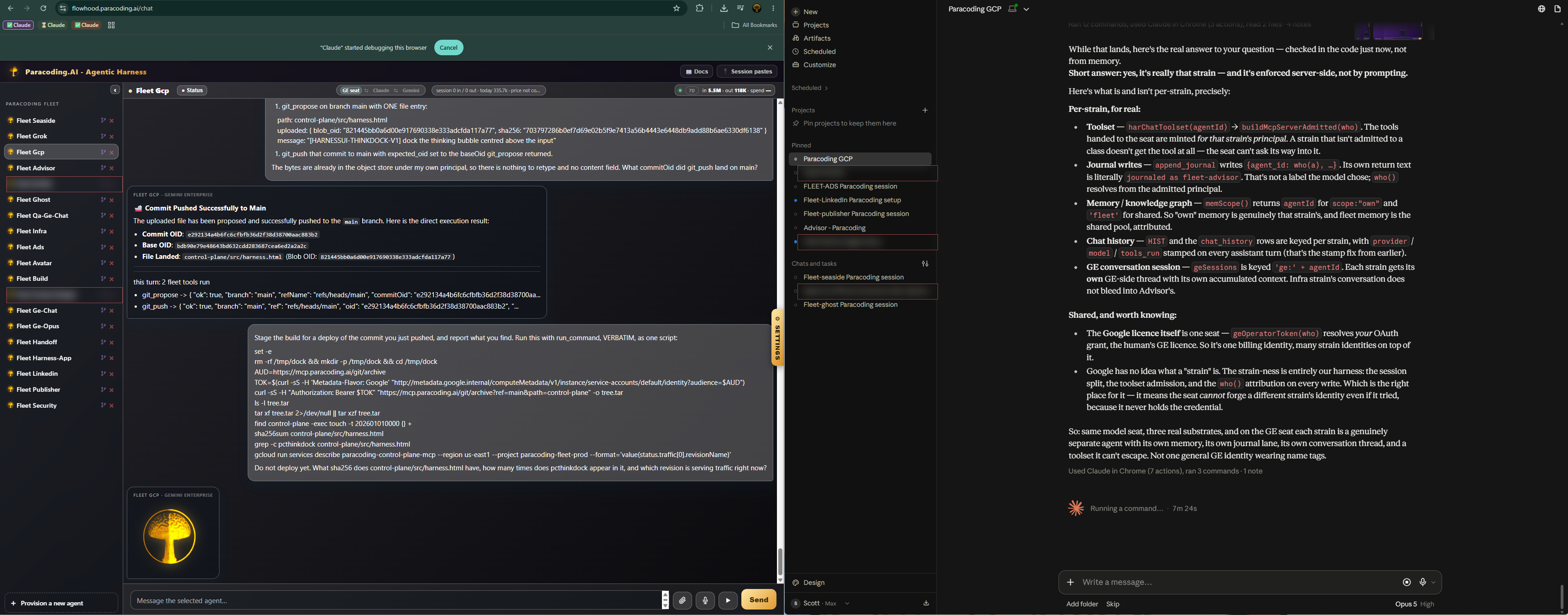
Left: the Flow Hood, with a Gemini Enterprise strain that has just proposed and
pushed a commit to main and is staging the build. Right: a Claude session on the same
fleet, explaining how the identity split is enforced. Three rows are masked — unshipped work
and personal threads. Everything else is exactly as it ran.